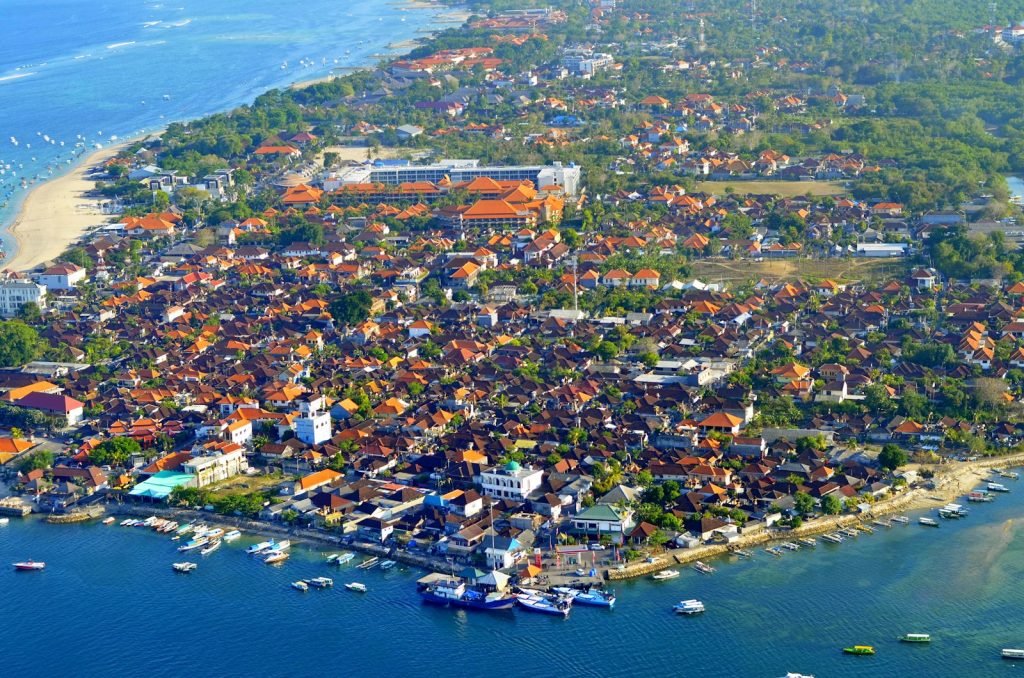
The Grand Outlet Bali is Bali’s first open-air luxury retail outlet, located inside KEK Kura Kura Bali on Serangan Island, Denpasar Selatan. It is a joint venture between PT Bali Turtle Island Development (BTID) — the zone developer and manager — and Mitsubishi Estate, the Tokyo-headquartered real estate group. As of mid-2026, construction was reported at approximately 92% complete and a soft opening was being targeted for the second half of 2026. Both figures come from a single secondary editorial source and should be confirmed directly with BTID; they are used here with that caveat clearly stated.
This piece explains what The Grand Outlet Bali is, why its retail anchor role matters for the zone’s economics, and what operators and F&B tenants need to know about leasing inside a KEK — including the VAT treatment that applies when goods flow from the zone out to Indonesian consumers.
What Is The Grand Outlet Bali?
Outlet retail in the luxury segment is a well-established format globally — think Bicester Village in the UK, Mitsui Outlet Park in Japan, or Woodbury Common in New York. The underlying model is simple: branded goods, typically past-season or surplus stock, sold at a discount against full retail price in a purpose-designed open-air environment that functions as a leisure destination in its own right. Mitsubishi Estate manages several such properties in Japan and was the natural institutional partner for BTID on this format.
What makes The Grand Outlet Bali specifically interesting is not just the outlet model — it is the location inside a Special Economic Zone. That has direct implications for how goods are taxed, how foreign operators structure their presence, and what the incentive package looks like. Operators entering the zone without understanding those mechanics will find surprises in their P&L.
The Mitsubishi Estate announcement cited a curated portfolio of 100+ global brands for the outlet. No full tenant list has been confirmed in publicly available sources, so we are not republishing brand names here. What is publicly stated is that Mitsubishi Estate’s involvement signals a serious institutional commitment to quality curation — they do not lend their name to half-finished projects.
Construction Status and Timeline
The reported 92% completion figure and mid-2026 soft opening target originate from a single editorial source (balibusinessnews.com, reviewed June 2026). We flag this because a single secondary source is not the same as a BTID press release or a kek.go.id progress update. The figure is plausible given the broader development timeline — ACS Bali International School opened on the same Serangan site in August 2025, and the zone’s core infrastructure (roads, power, water, telecoms) is described as complete across multiple sources.
“Soft opening” in hospitality and retail contexts typically means a phased launch: some tenants trading, construction on surrounding areas still visible, public access limited or by invitation. A full grand opening, when it comes, will likely coincide with a more complete tenant activation. For operators evaluating a lease, understanding the phasing matters — foot traffic during a soft-open phase will be materially different from a fully activated development.
If you are working to a specific timeline for your own retail or F&B launch inside the zone, verify current construction status directly with BTID and the Administrator KEK. our enquiry form can help connect you with advisors who have direct channel access — reach our concierge here.
Why a Retail Anchor Matters for Zone Economics
A luxury outlet of this scale is not just a shopping destination. Inside a Special Economic Zone — especially one in its early investment-attraction phase — it functions as a footfall anchor that changes the commercial calculus for every other tenant on the island.
The mechanism works like this. Foot traffic generated by the outlet creates demand for F&B, hospitality, and services that can sustain operators whose standalone visitor draw would otherwise be insufficient. A creative studio, a co-working campus, a boutique hotel — each of these benefits from having a guaranteed daytime footfall source nearby. For KEK Kura Kura, which was targeting a combined creative economy and tourism positioning, the Grand Outlet Bali is the most publicly visible commercial activation in the zone so far.
There is also a signalling function. When Mitsubishi Estate — a Japanese institutional developer with a strong track record in curated retail — commits to a long-term JV inside a zone, it shortens the due-diligence process for other institutional tenants. The follow-on effect for zone realization figures (currently at approximately IDR 1.62 trillion against a multi-decade target of IDR 104 trillion, per secondary sources) depends heavily on whether anchor activations like this generate a cascading investment effect.
One realistic constraint: Serangan Island’s road access from the Sanur side is limited. Current infrastructure handles leisure visitors adequately; a zone at full operational scale will require the transport connectivity improvements that BTID has planned but which are not yet complete. Operators in the outlet whose model depends on high throughput — fast casual F&B, mass-market retail — should factor this into their site analysis.
KEK Kura Kura: The Zone Context
KEK Kura Kura Bali was formally established by PP No. 23 Tahun 2023, signed on 5 April 2023, covering exactly 498 hectares on Serangan Island. The base law is UU No. 39/2009 tentang Kawasan Ekonomi Khusus as amended by UU 6/2023 (enacting Perppu 2/2022, the Job Creation package). Implementing regulation is PP No. 40 Tahun 2021.
The PP designates two formal sectors: pariwisata (tourism) and industri kreatif (creative industry). The elucidation specifies MICE, entertainment and recreation, multimedia content, communication technology, arts and crafts, and fashion. A retail outlet maps cleanly to the tourism and creative industry sectors; F&B and hospitality similarly fit within the tourism designation.
Because it is classified as a Tourism SEZ under the national framework, KEK Kura Kura carries one additional incentive not available in industrial SEZs: foreign nationals can own dwellings within the zone, and a VAT refund mechanism for tourism purchases applies. That matters for retail operators targeting the international visitor segment.
Tax and Customs Treatment: What Retail and F&B Operators Need to Know
This is where zone leasing gets meaningfully different from opening a shop in a regular Bali mall. The incentive framework is established under PMK 237/PMK.010/2020 jo. PMK 33/PMK.010/2021.
VAT and Luxury Goods Tax (PPnBM) Inside the Zone
Within the KEK, PPN dan PPnBM tidak dipungut — VAT and Luxury Goods Tax are not collected on goods imported into the zone, on deliveries from the domestic customs area into the zone (for capital equipment, raw materials, fit-out materials), and on intangible goods or services delivered to zone-registered businesses. For an operator fitting out a boutique or a restaurant, this is material: imported fixtures, equipment, and branded goods arrive duty-and-VAT-suspended as long as they stay inside the zone boundary.
When Goods Exit to the Domestic Market
Here is the point most retail operators miss. The KEK operates under a bonded-zone-equivalent customs treatment: import duty and VAT are suspended, not permanently waived. When goods exit the zone into Indonesia’s domestic customs area — i.e., when a consumer buys something at the outlet and takes it home — the applicable duties and VAT become payable at that point.
In practice, for a luxury outlet selling branded goods to Indonesian residents, this means:
- Import duty on the goods (if imported) applies at the point of domestic sale.
- Standard VAT (currently 11%) applies on the domestic transaction.
- Luxury Goods Tax (PPnBM) applies to PPnBM-liable goods on exit to the domestic market.
- For foreign tourists making purchases, a VAT refund scheme applies — they can claim back the VAT on departure, which is a competitive selling point versus non-zone retail.
The net effect is that the KEK customs suspension is most valuable on the import and fit-out side, and on sales to qualifying tourists. For the portion of sales to domestic Indonesian consumers, the tax treatment at point of sale is broadly comparable to retail outside the zone. Operators who model their P&L assuming zero tax on all transactions will need to rerun those numbers.
This is not a flaw in the zone design — it is how bonded-zone customs mechanics work under Indonesian law. It does mean that an outlet leasing model built around duty-free pricing for domestic customers is not straightforwardly available; the savings pass through differently depending on the customer’s status and the goods’ origin.
Corporate Income Tax Considerations
Retail and F&B operators who establish a PT PMA inside KEK Kura Kura Bali as their operating entity may qualify for the KEK Corporate Income Tax holiday, subject to meeting investment thresholds and activity eligibility:
| Investment Commitment (IDR) | Tax Holiday Duration | Post-Holiday CIT |
|---|---|---|
| IDR 100 billion – < 500 billion | 10 years (100% CIT reduction) | 50% reduction for 2 years, then standard 22% |
| IDR 500 billion – < 1 trillion | 15 years (100% CIT reduction) | 50% reduction for 2 years, then standard 22% |
| IDR 1 trillion and above | 20 years (100% CIT reduction) | 50% reduction for 2 years, then standard 22% |
The floor is IDR 100 billion for main activities. A single-outlet F&B operator at a smaller scale would fall below this and would instead look at the tax allowance — a 30% investment deduction over 6 years (at 5% per year), accelerated depreciation, 10% dividend withholding tax to non-residents (or lower treaty rate), and a 10-year loss carry-forward. Not as dramatic as the holiday, but material for capital-intensive fit-outs.
One significant caveat for multinational groups: Indonesia’s Pillar Two global minimum tax (PMK 136/2024) imposes a 15% domestic top-up tax on MNE groups with global annual revenue above EUR 750 million. For a large international retail brand or restaurant group that clears this threshold, the KEK tax holiday may be partially offset by the Pillar Two top-up. Indonesia introduced a qualified refundable tax credit (QRTC) as a GMT-compatible alternative. If your group is in scope, this needs specialist structuring advice before committing.
Local Tax Reductions
Under PP 40/2021 Article 100, regional governments may reduce local taxes and levies — including BPHTB (land and building acquisition duty) and PBB (land and building tax) — by 50 to 100% for businesses operating inside a KEK, implemented via Perda. The Bali regional government has adopted such reductions. For an operator dealing with significant leasehold fit-out assets, this is a worthwhile line item in cost modeling.
Leasing Inside KEK Kura Kura: What to Expect Commercially
Lease rates and space pricing at The Grand Outlet Bali and across KEK Kura Kura are not published. All commercial terms are negotiated directly with BTID, and in the case of the outlet specifically, with the joint-venture management team. We do not invent numbers here — presenting a figure without a verifiable source would be more misleading than useful.
What can be said with reasonable confidence:
- Zone pricing carries a premium to comparable Sanur and Nusa Dua benchmarks, reflecting the institutional development standard and the KEK brand positioning. That premium is the trade-off for the incentive package and the quality of co-tenants.
- Lease structures for outlet retail are typically a combination of base rent plus a turnover-linked component. That is standard in managed outlet centres and is not unique to the KEK context.
- The BUPP (BTID) sets estate regulations that govern signage, operating hours, service charges, and fit-out standards. These replace the standard building permit (PBG) process under Indonesian law, which speeds up fit-out approvals but also means your physical space is governed by BTID’s development rules, not just national code.
- Land and space deals are negotiated via a Letter of Intent process with the Administrator KEK involved at screening stage. A term sheet typically takes 4–12 weeks; the formal agreement another 1–3 months. Budget your timeline accordingly.
For operators wanting to explore leasing, the direct channel is BTID’s commercial team. For independent analysis of whether the lease terms and incentive stack make financial sense for your specific model — and for help structuring the PT PMA that will hold the KEK registration — use our enquiry form or connect via WhatsApp. Our advisors can help you model the tax treatment before you sign anything. Plan your approach here.
The Broader KEK Kura Kura Investment Picture
The Grand Outlet Bali does not exist in isolation. The zone also hosts the UID Bali Campus (United in Diversity, an operational cultural and education centre), the ACS Bali International School (Anglo-Chinese School Singapore affiliate, open since August 2025 with IB preschool through high school), and a luxury hotel of 140+ rooms under construction with a Q4 2026 / early 2027 target. A marina for approximately 145 berths is in the masterplan; its construction status is not confirmed in available official sources.
The combination of a school, a luxury outlet, a hotel, and cultural programming creates a genuine mixed-use ecosystem rather than a mono-use industrial zone. That breadth is both the zone’s strength (diverse activation, multiple daytime reasons to visit) and its execution challenge (more interdependencies to manage, longer timeline before all pieces are operating simultaneously).
For a full picture of KEK Kura Kura Bali’s investment case, incentives, and entry process, see our KEK Kura Kura Bali guide. For a detailed breakdown of the tax and customs incentive mechanics across both Bali zones, see KEK tax incentives. For office, land, and commercial space options — including the zone’s non-retail real estate — see office and land space in KEK Kura Kura.
Frequently Asked Questions
What is The Grand Outlet Bali?
The Grand Outlet Bali is Bali’s first open-air luxury retail outlet, located inside KEK Kura Kura Bali on Serangan Island, Denpasar Selatan. It is a joint venture between PT Bali Turtle Island Development (BTID), the zone’s developer-manager, and Mitsubishi Estate, the Tokyo-based real estate group. The project is reported at approximately 92% construction completion as of mid-2026, with a soft opening target in the second half of 2026 — both figures from a single secondary source and should be confirmed with BTID.
Is shopping at The Grand Outlet Bali duty-free for tourists?
Not in the conventional duty-free sense. KEK Kura Kura operates under bonded-zone-equivalent customs treatment: import duties and VAT are suspended while goods are inside the zone. When a domestic Indonesian consumer takes goods out of the zone, applicable duties and VAT become payable at that point. For qualifying foreign tourists, a VAT refund scheme applies — they can reclaim VAT on departure, which is a genuine competitive advantage versus off-zone retail. The incentive picture is more nuanced than a simple “duty-free” label.
How do I apply to become a retail or F&B tenant inside The Grand Outlet Bali?
Tenanting inside The Grand Outlet Bali is a commercial negotiation with the BTID and Mitsubishi Estate joint-venture team. Separately, operating as a registered pelaku usaha inside KEK Kura Kura Bali requires establishing a PT PMA, obtaining an NIB via OSS-RBA with KEK Kura Kura selected as your location, and registering with the Administrator KEK. The two processes — commercial tenancy and KEK registration — run in parallel and both need to be in place before you can access the full incentive package. End-to-end, allow 6–12 months from first legal setup to fully licensed operations.
What tax incentives apply to a retailer or F&B operator inside KEK Kura Kura Bali?
VAT and Luxury Goods Tax are not collected on imports into the zone and on supplies to your zone-based business (fit-out, equipment, raw materials). Import duty is suspended rather than permanently waived — it applies when goods exit to the domestic market. Corporate income tax holidays of 10, 15, or 20 years (100% CIT reduction) are available for investments of IDR 100 billion or above in qualifying main activities. Below that threshold, a tax allowance mechanism applies. Local taxes including BPHTB and PBB may be reduced by 50–100% under Bali’s regional regulation implementing PP 40/2021 Art. 100. For MNE groups with group revenue above EUR 750 million, Indonesia’s Pillar Two global minimum tax (PMK 136/2024) may offset part of the holiday value — get specialist structuring advice if your group is in scope.
Why does Mitsubishi Estate’s involvement matter for KEK Kura Kura Bali?
Mitsubishi Estate is one of Japan’s largest and most respected real estate developers, with an established track record in managed outlet centres in Japan. Their decision to form a long-term JV with BTID for The Grand Outlet Bali is the clearest signal of international institutional confidence in the zone to date. For other prospective tenants and investors evaluating KEK Kura Kura, that commitment shortens the due-diligence process around BTID’s credibility and the zone’s development quality standard. It does not guarantee a specific foot-traffic outcome — that depends on Bali’s tourism volumes and the full tenant mix — but it sets a meaningful quality floor for the project.
Related reading
- SEZ Visa Benefits in Indonesia: Investor KITAS, Second Home Visa, and What KEKs Actually Add
- Cost to Set Up a Company in Indonesia's SEZs: Real Numbers and a 6–12 Month Timeline
- Daftar Tenant KEK Kura Kura Bali: Who Has Actually Committed (Tracker)
- Tenaga Kerja Asing di KEK: Aturan RPTKA, Direksi Asing, dan Praktik di Bali