KEK Kura Kura Bali is a Special Economic Zone (Kawasan Ekonomi Khusus) covering exactly 498 hectares on Serangan Island, Kecamatan Denpasar Selatan, established by Government Regulation PP No. 23 Tahun 2023, signed on 5 April 2023. The zone’s designated sectors under the PP are tourism and creative industry — encompassing MICE, entertainment, multimedia content, communication technology, arts, crafts, and fashion. The zone manager and developer is PT Bali Turtle Island Development (BTID), appointed under the PP framework; its exact shareholder structure is not confirmed in publicly available official documents and is not stated here.
If you are researching the zone as an investor, prospective tenant, or policy analyst, this page compiles what the regulation actually says, what is verifiably built, what the targets are, and where the honest uncertainties sit. We source figures to PP texts and official government releases. Where data conflicts across sources, we say so. use our enquiry form or WhatsApp to speak with our vetted advisors about entry structure.
Location and Physical Context
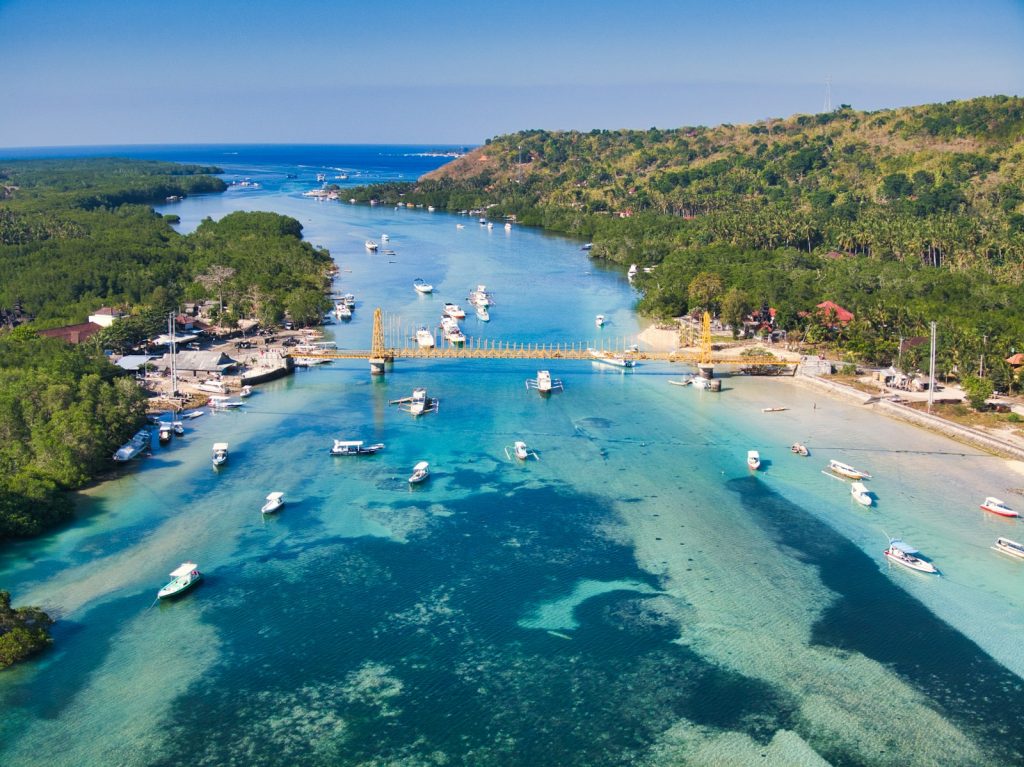
Serangan Island sits south of Sanur, roughly 15 minutes from central Denpasar, 20 minutes from Ngurah Rai Airport, and 30 minutes from the main resort corridor in Seminyak and Nusa Dua. The zone is bounded by Serangan village and the Badung Strait. That proximity to the airport is a genuine logistical advantage for a creative and hospitality district — compared with, say, an industrial SEZ in East Java, the labour pool and existing tourism infrastructure are right there.
The island itself has a contested history. The 1990s reclamation that expanded Serangan’s land area — long before any SEZ designation — drew criticism over coastal erosion and impacts on local fishing communities. That social and environmental context does not disappear because a PP was signed in 2023. Investors doing due diligence should read the community dimension alongside the headline numbers.
Of the 498 ha, roughly 60% has been reported as development-ready (core roads, power, water, and telecoms), though that figure comes from a single secondary source and should be confirmed directly with BTID. The PP imposed a 36-month ready-to-operate obligation from the date of designation — a deadline that fell around April 2026.
Formal Sectors: What the PP Actually Permits
PP 23/2023 designates KEK Kura Kura Bali for two sectors: pariwisata (tourism) and industri kreatif (creative industry). The PP’s elucidation specifies sub-activities: MICE, entertainment and recreation, multimedia content production, communication technology, arts and crafts, and fashion.
You will frequently read references to a “tech park,” “knowledge district,” or “education hub” in relation to Kura Kura. Those phrases come from BTID’s master plan and from announcements about specific tenants — they are not formal PP sector categories. The distinction matters for incentive eligibility. A technology company claiming the formal creative-industry sector classification must map its KBLI (business classification code) to one of the elucidated activities. If your business does not fit cleanly, confirm the KBLI mapping with the Administrator KEK and an OSS specialist before committing to a lease.
The zone is classified as a Tourism SEZ, which carries one additional incentive: foreign nationals can own property (dwelling) within the zone, and VAT refund rules for tourism-linked goods apply. This is distinct from the general KEK regime and from ownership rights outside the zone.
What Is Actually Built, Under Construction, and Planned
The table below consolidates verified status as of mid-2026. We label sources and flag unverified claims rather than present a uniformly confident picture.
| Asset | Status | Notes / Source Confidence |
|---|---|---|
| Core infrastructure (roads, power, water, telecoms) | Complete | Consistent across multiple sources including kek.go.id updates |
| UID Bali Campus (Unity in Diversity) | Operational | Cultural and education centre — verified operational |
| ACS Bali International School | Open (August 2025) | Anglo-Chinese School Singapore affiliate; IB preschool through high school — verified |
| The Grand Outlet Bali | ~92% complete, soft opening targeted mid-2026 | JV between BTID and Mitsubishi Estate; first open-air luxury retail outlet in Bali. Figure from single secondary source — confirm with BTID |
| Unnamed luxury hotel (~140+ rooms) | Under construction | Target Q4 2026 / early 2027; operator and brand not named in available sources |
| Tsinghua Southeast Asia Center | Planned / announced | Part of the knowledge hub narrative; current operational status unverified — do not treat as live without BTID confirmation |
| Marina (145-berth) | In master plan | No confirmed construction start date in available official documents — treat as planned, not built |
The Mitsubishi Estate partnership on the Grand Outlet Bali is the most commercially significant headline so far. Mitsubishi Estate brought a curated portfolio of 100+ global brands to the project — a strong anchor for the zone’s retail and creative economy positioning. Whether it translates into sustained foot traffic depends on how the Bali tourism market performs, which has its own volatility.
Investment Targets and Realized Progress
Official targets for KEK Kura Kura Bali, sourced to government releases and kek.go.id:
- Total investment target (to ~2052)
- IDR 104 – 104.4 trillion
- First-five-year investment target
- IDR 12 trillion (kek.go.id)
- Direct jobs target
- approximately 35,000
- Indirect jobs target
- approximately 64,000 – 64,800
- Forex contribution target
- US$31.8 billion (approximately IDR 481.6 trillion at prevailing rates)
- kek.go.id profile target
- IDR 89.9 trillion (an older figure still on the zone profile page — the IDR 104 tn figure comes from more recent Airlangga Hartarto statements; both are official, neither is wrong, they reflect different reference periods)
Realized progress as of April 2026: approximately IDR 1.62 trillion realized and around 2,100 jobs created, based on a secondary editorial source (balibusinessnews.com). A Ministry of Tourism release for S1-2025 cited IDR 260.96 billion — roughly 14.53% of that year’s annual target. These figures have not been independently cross-checked against kek.go.id’s live data or BTID’s investor reports. Treat them as directional, not definitive.
The context matters: IDR 1.62 trillion realized against a IDR 104 trillion lifetime target is approximately 1.5% of the endpoint. A 30-year buildout to 2052 means the zone is in its early chapters. That is neither surprising nor damning on its own — KEK Sanur, which had a two-year head start and a clearer anchor tenant in Bali International Hospital, had realized IDR 5.37 trillion by the same period. The comparison is useful for calibrating pace, not for writing off Kura Kura.
If you are evaluating the zone for a time-sensitive project, the pace of realization matters. If your planning horizon is 10-plus years and you are looking at the structural bet — Bali’s tourism volume, Indonesia’s creative economy trajectory, the anchor infrastructure — the current numbers look different. Both lenses are valid; neither should be hidden.
Fiscal Incentives for Pelaku Usaha
Being inside KEK Kura Kura Bali unlocks a specific incentive package, governed primarily by PP 40/2021 and PMK 237/PMK.010/2020 jo. PMK 33/PMK.010/2021. The base law is UU No. 39/2009 tentang Kawasan Ekonomi Khusus, as amended by UU 6/2023 (which enacted Perppu 2/2022 on Job Creation).
Corporate Income Tax Holiday
Available for kegiatan utama (main business activities within the designated sectors), with a minimum investment of IDR 100 billion:
| Investment Commitment | Tax Holiday Duration | Post-Holiday Tail |
|---|---|---|
| IDR 100 bn – < IDR 500 bn | 10 years (100% CIT reduction) | 50% CIT reduction for 2 further years |
| IDR 500 bn – < IDR 1 tn | 15 years (100% CIT reduction) | 50% CIT reduction for 2 further years |
| IDR 1 tn and above | 20 years (100% CIT reduction) | 50% CIT reduction for 2 further years |
Standard CIT after the holiday: 22%. The investment commitment typically needs to be realized within approximately four years. Applications are filed through the OSS system and must be submitted before commercial operations begin — filing after you open is a disqualifying error.
One candor point for larger investors: Indonesia’s Pillar Two global minimum tax (GMT) framework — PMK 136/2024 — imposes a 15% domestic top-up tax on MNE groups with annual revenue exceeding EUR 750 million. If your group meets that threshold, the CIT holiday may still leave a top-up liability, effectively eroding the net benefit. Indonesia introduced a qualified refundable tax credit (QRTC) mechanism as a GMT-compatible alternative. If you are in scope, get specialist advice on holiday vs QRTC structuring before filing.
Tax Allowance
For activities that do not qualify for the holiday (below the IDR 100 bn floor, non-main activities, or where the taxpayer elects the allowance): a 30% investment deduction applied over 6 years (5% per year), accelerated depreciation and amortization, 10% dividend withholding tax for non-resident shareholders (or lower treaty rate), and a 10-year loss carry-forward.
Indirect Tax Facilities
- PPN dan PPnBM tidak dipungut — VAT and Luxury Goods Tax not collected on imports into the zone, deliveries from the domestic customs area into the zone, and intangible goods or services delivered to zone businesses (capital goods, machinery, raw materials, land and buildings).
- Import duty exemption or postponement — bonded-zone-equivalent treatment; duty arises only when goods exit to the domestic market.
- PPh 22 import not collected on qualifying imports.
- Excise exemption and suspension for qualifying goods.
- Local tax reductions of 50–100% — under PP 40/2021 Article 100, regional governments may (and Bali has) reduce local taxes and levies including BPHTB (land and building acquisition duty) and PBB via regional regulation.
Tourism SEZ extras specific to Kura Kura: VAT refund for tourists, PPnBM exemption on dwelling purchases by foreign nationals within the zone.
Non-Fiscal Facilities
Beyond the tax package, the KEK framework delivers several structural advantages that can matter more to daily operations than the CIT holiday.
Land Rights
Under Indonesia’s land law as amended by the Cipta Kerja package (PP 18/2021), investors can obtain HGB (Hak Guna Bangunan — Right to Build) in cycles of 30+20+30 years, totalling up to 80 years before renewal. This is a meaningful improvement on the 30-year base term that applies outside the zone. A note on precision: the 80-year upfront grant in a single certificate applies specifically to IKN (the new capital) under its own PP — in KEK, the standard mechanism is the 30+20+30 renewal cycle. Foreign individuals cannot hold HGB or Hak Milik (freehold) directly; the route is via a properly structured PT PMA holding the HGB, or Hak Pakai (Right to Use) for qualifying individual foreign holders.
One-Stop Licensing via Administrator KEK
The Administrator KEK functions as an integrated licensing authority — the zone’s own PTSP (Pelayanan Terpadu Satu Pintu). Licenses that would normally involve multiple Jakarta ministries are processed through this single gateway using the OSS-RBA (Online Single Submission — Risk-Based Approach) platform. In practice, this shortens turnaround for most business licenses from months to weeks. It does not eliminate the need for thorough documentation, and it does not override national-level restrictions on specific sectors.
Immigration Facilitation
KEK designation streamlines — but does not fundamentally change — Indonesia’s immigration instruments. Investors and their families can use the standard Investor KITAS; foreign workers enter through the RPTKA (foreign worker placement plan) process, which is expedited for zones designated as national strategic programs. The Visa on Arrival, extendable up to five times, applies nationwide but is practically useful for initial reconnaissance visits. Claims of a unique “KEK residence permit linked to property purchase” typically refer to the national Second Home Visa (Permenkumham 22/2022, 5- or 10-year stay) — it is not a KEK-specific instrument, though it functions well in combination with zone property ownership. Exact PP 40/2021 article references for immigration easements should be confirmed at the primary text before citing in legal documents.
Other Structural Easements
- No negative investment list restrictions within the zone (subject to sector eligibility and KBLI mapping — do not interpret this as blanket 100% foreign ownership; verify per KBLI).
- Developer estate regulations replace individual building permit (PBG) requirements where the BUPP has issued zone-wide development rules.
- Environmental permits for common infrastructure are handled at zone level by BTID; individual tenants face only activity-specific AMDAL requirements.
- SNI (Indonesian National Standard) certification requirements are relaxed for qualifying activities.
- No export obligation — tenants with import-duty-suspended goods can sell domestically on payment of applicable duties.
Ready to map your entry structure? use our enquiry form or reach us on WhatsApp to speak with a specialist who knows both zones. We will match you to the right advisor for your sector, timeline, and investment size — plan your approach here.
How to Become a Pelaku Usaha: Entry Path Summary
A pelaku usaha (business actor) inside KEK Kura Kura Bali is a company that has formally registered within the zone and is entitled to the KEK incentive package. The sequence is not complicated, but each stage has dependencies.
- Establish your PT PMA — Indonesia’s foreign-owned limited liability company. Minimum investment plan under the current OSS regime is IDR 10 billion per 5-digit KBLI, excluding land and buildings; paid-up capital in practice is typically IDR 10 billion. Incorporation takes 2–4 weeks with a competent notary and legal team.
- Obtain your NIB via OSS-RBA — the NIB (Nomor Induk Berusaha, business registration number) is the gateway credential. During OSS submission, you select KEK Kura Kura as your business location. This takes days once the PT PMA is registered.
- LOI and screening with Administrator KEK — submit a Letter of Intent and project description to the Administrator KEK. The Administrator reviews your activity against the zone’s permitted KBLI list and the BUPP’s development plan. Allow 2–6 weeks depending on project complexity.
- Space or land agreement with BTID — this is the commercial negotiation. Lease rates and land prices inside the zone are not published; they are negotiated directly with BTID on terms reflecting the zone’s premium location and the specific parcel or built space. Term sheets typically take 4–12 weeks; formal agreements 1–3 months. Budget accordingly.
- File for fiscal facilities through OSS before commercial operations begin — this is where most investors lose value by moving too fast. The tax holiday application must be filed through the OSS system prior to opening. Ministry of Finance processing takes 1–3+ months; systems delays can extend this. Do not start revenue-generating activity before the facility is in place.
- Customs registration and IT inventory system (if using duty-suspension facilities) — 1–3 months depending on systems readiness and your customs advisor.
Realistic end-to-end timeline from first notary meeting to fully facility-enabled operations: 6 to 12 months. The PT+NIB piece is fast; the space deal and fiscal facility stages set the pace. Indicative professional fees (not regulated costs — label as estimates): PT PMA incorporation IDR 20–50 million; advisors for the full process IDR 100–500 million for mid-scale projects. Neither BTID nor the Administrator KEK publishes a fee schedule for the commercial elements.
A detailed step-by-step process guide — including OSS forms, Administrator KEK document requirements, and incentive-revocation trigger clauses — is on our becoming a pelaku usaha page.
The Bali IFC Vision and What Currently Exists
From April–May 2026, President Prabowo’s government announced a Bali International Financial Centre (IFC) concept, with Kura Kura as a candidate location. The Global Blended Finance Alliance (GBFA), which held a G20-adjacent roundtable in Bali, backed the concept. Figures cited in coverage include a projected US$6.3 billion in IFC-linked investment and a “proposed 0% tax rate.”
The honest position as of mid-2026: there is no IFC regulatory framework in place, no financial authority established, and no enacted KEK-specific financial-centre law. The announcement is a policy intent, not a legal instrument. Comparing Kura Kura to Singapore’s MAS or Dubai’s DIFC on the basis of this announcement overstates where the zone currently sits. That does not mean the IFC concept has no merit — Indonesia’s structural case for a financial hub (capital controls, BPJS managed-care savings, the sovereign wealth fund trajectory) is real. It means due diligence should track legislative and regulatory milestones, not press releases. We will maintain a tracker on our blog.
Candid Risk Assessment
We apply the same risk lens to Kura Kura that we would to any zone in our coverage. These are not reasons to avoid the zone; they are factors to price into any decision.
- Long buildout horizon. The 2052 target date is ~30 years away and spans multiple tourism cycles. COVID demonstrated how rapidly Bali’s visitor economy can contract. A creative and tourism zone is more exposed to that cycle than, say, an industrial logistics hub.
- Realization pace. IDR 1.62 trillion against a IDR 104 trillion target is early-stage. The 14.53% of the 2025 annual target reported for the first half of 2025 (kemenpar.go.id) suggests the ramp has not hit scale. Early entry can mean better terms; it also means lower certainty on co-tenants and surrounding activation.
- Environmental and community scrutiny. Serangan’s reclamation history generates ongoing attention from environmental and community groups. Adverse rulings or social friction — while not currently acute — remain a tail risk in Indonesian land-use disputes.
- Infrastructure access. Road access from the Sanur side is constrained. BTID’s development plan addresses this; current conditions are a practical consideration for logistics-dependent businesses.
- Pillar Two GMT exposure. For MNE groups above the EUR 750 million revenue threshold, the standard KEK tax holiday no longer delivers its nominal value without a QRTC mechanism. This is a material change since PMK 136/2024 took effect in October 2024.
- Incentive revocation risk. Under PP 40/2021, Dewan Nasional KEK evaluates zone performance. Zones that persistently miss targets can lose their KEK designation. This has not happened to Kura Kura; the framework exists. Incentives can also be redesigned prospectively by new regulation.
- Zone proliferation. Indonesia has been expanding its SEZ roster — the Prabowo government has signalled a “KEK in every province” ambition. More zones competing for the same pool of investors could dilute Kura Kura’s relative advantage over time.
Academic research on Indonesia’s SEZ program overall (see VoxDev, 2023) found minimal aggregate impact on regional growth and welfare, with weak spillover effects — particularly for remote-location zones. Kura Kura’s location is not remote, and its tourism-sector anchor is genuinely different from the industrial zones that drove those findings. Still, the evidence base for SEZ productivity effects in Indonesia is not uniformly positive.
KEK Kura Kura Bali vs KEK Sanur: A Quick Orientation
Both Bali zones sit in Denpasar Selatan. Beyond that, they serve different investor profiles.
| Dimension | KEK Kura Kura Bali | KEK Sanur |
|---|---|---|
| Legal basis | PP 23/2023 (5 April 2023) | PP 41/2022 (1 November 2022) |
| Area | 498 ha | 41.26 ha |
| Formal sectors | Tourism + Creative Industry (MICE, entertainment, multimedia, comms tech, arts, fashion) | Health + Medical Tourism |
| Zone developer (BUPP) | BTID | Hotel Indonesia Natour / InJourney (health cluster: IHC/Pertamina Bina Medika) |
| Anchor tenant | ACS School, UID Campus, Grand Outlet Bali (Mitsubishi Estate JV) | Bali International Hospital (IHC + Mayo Clinic collaboration) |
| Realized investment (Apr 2026, secondary source) | ~IDR 1.62 tn | ~IDR 5.37 tn |
| Best fit for | Retail, creative economy, education, hospitality, long-horizon mixed-use | Medical operators, health-tech, wellness, patient services |
The right zone depends entirely on your sector. A medical device importer belongs in Sanur; a luxury retail brand or multimedia production studio belongs in Kura Kura. If you are evaluating both — perhaps for a wellness-and-hospitality proposition — they are genuinely complementary rather than competing. Full Sanur profile: see our KEK Sanur guide.
Key Regulatory and Governance Entities
Dewan Nasional KEK — the National SEZ Council, chaired by the Coordinating Minister for Economic Affairs. It approves zone designations, reviews performance, and can recommend revocation. Its decisions are legally binding and are the ultimate policy-risk variable for any zone investment.
Administrator KEK Kura Kura — the zone-level one-stop service authority. All licensing and regulatory interactions for tenants run through here. For practical purposes, this is your primary government interlocutor once inside the zone.
BTID (PT Bali Turtle Island Development) — the BUPP (Badan Usaha Pembangun dan Pengelola); builds zone infrastructure and manages the estate. All space and land deals go through BTID. Its communications team is the first contact point for commercial inquiries.
Mitsubishi Estate — Japanese real estate developer, JV partner for The Grand Outlet Bali. Their involvement is the clearest signal of international institutional confidence in the zone.
OSS-RBA — the national online licensing platform (oss.go.id) through which all NIB applications, business license variations, and fiscal facility applications are filed. Zone-specific features are unlocked once you select KEK Kura Kura as your business location during registration.
Want to talk through whether KEK Kura Kura Bali fits your investment structure? use our enquiry form or connect with us on WhatsApp — reach our concierge here. We do not push a single option; we walk through the trade-offs and connect you with the right specialist for your situation.
Frequently Asked Questions
What is KEK Kura Kura Bali and where exactly is it located?
KEK Kura Kura Bali is a 498-hectare Special Economic Zone (Kawasan Ekonomi Khusus) on Serangan Island, Kecamatan Denpasar Selatan, designated by Government Regulation PP No. 23 Tahun 2023 on 5 April 2023. It sits roughly 15 minutes from central Denpasar and 20 minutes from Ngurah Rai International Airport. The zone is developed and managed by PT Bali Turtle Island Development (BTID).
Which business sectors are permitted inside KEK Kura Kura Bali under PP 23/2023?
The formal sectors under PP 23/2023 are tourism and creative industry (industri kreatif). The PP’s elucidation lists specific activities: MICE, entertainment and recreation, multimedia content, communication technology, arts and crafts, and fashion. References to a “tech park” or “education hub” reflect BTID’s master plan, not the formal regulatory sector categories. A business’s eligibility for KEK incentives depends on its KBLI code matching the designated activities — verify this with the Administrator KEK before committing to a lease.
How long is the tax holiday for investors in KEK Kura Kura Bali?
The KEK tax holiday (100% CIT reduction) lasts 10 years for investments of IDR 100–499 billion, 15 years for IDR 500 billion to under IDR 1 trillion, and 20 years for IDR 1 trillion and above, followed by a 50% CIT reduction for two additional years in each case. The minimum qualifying investment is IDR 100 billion for main activities. Companies with annual group revenue above EUR 750 million should also assess the Pillar Two global minimum tax (PMK 136/2024) impact, which can partially offset holiday value via a top-up levy.
How do I register as a pelaku usaha (business actor) in KEK Kura Kura Bali?
The standard path: incorporate a PT PMA in Indonesia, obtain your NIB via OSS-RBA selecting KEK Kura Kura as your location, submit an LOI to the Administrator KEK, negotiate a land or space agreement with BTID, and file for fiscal facilities through OSS before commencing commercial operations. Realistic end-to-end timeline is 6–12 months. Detailed process documentation is on our pelaku usaha entry guide.
What is the current investment realization progress at KEK Kura Kura Bali?
Based on available secondary sources (not yet cross-verified against kek.go.id’s live data), realized investment stood at approximately IDR 1.62 trillion and around 2,100 jobs by April 2026. A Ministry of Tourism release for the first half of 2025 cited IDR 260.96 billion — about 14.53% of that year’s annual target. The long-term investment target is IDR 104–104.4 trillion by approximately 2052. Current realization is early-stage relative to the headline target; the zone is in active development, not at scale. We track updates on our progress blog as official data is released.
Related reading
- Is Kura Kura Bali a Good Investment? An Independent Read of the Evidence
- Setting Up a Clinic in KEK Sanur: Tenant Route, Licensing, and Patient-Volume Math
- KEK Adalah: Pengertian Kawasan Ekonomi Khusus, Dasar Hukum, dan Contohnya di Bali
- KEK Non-Fiscal Incentives: Licensing, Land, Immigration, and Workers in Bali's SEZs